
Vancian magic eh?
I’ve played the level based D&D magic system over many years in all sorts of adventures, and frankly had a great time with it.
In the last two years I’ve also read some of Vance’s mage stories, and LOVE the basic idea that spells are so complex and powerful that the wizard can only hold a few in her mind at once. I forget which story it was now, but I recall one where a (highly experienced) magician memorized “The Excellent Prismatic Spray” and a couple other spells – and that’s all his brain could handle! Mages in D&D are allowed many more in comparison, but the general approach is similar; memorize spells, cast, then you need to re-memorize again.
Memorization and Spellbooks

In Tales of Argosa, there’s no strict requirement to memorize/allocate particular spells to your casting slots (the Magic User is more like a 5e Sorcerer or Lowlife 2090 Mage in that sense), but we’ve adopted similar reasoning about why Magic Users require access to their spellbook(s).
Levelless Spells
So how is magic changing in ToA?
Well first up we’re switching to Levelless Spells!
Yes, I know I said I liked Vancian magic, and I do (esp the memorization mini game). But going levelless has allowed us to do several things:
- Cut down the spell list (mainly merging high and low level variants into a single spell, or removing very niche magics),
- Rebalance some spells. Why hello Insidious Slumber and Curse of Searing Steel! Oh don’t act like you didn’t see us coming!
- Standardise the Magic User class, and
- Offer starting PCs a broader range of spells to learn.
Out of the 120 spells in Low Fantasy Gaming (20 spells/level from 1st – 6th), we condensed them into a crack squad of 50 fearsome dweomers, ready and waiting to be unleashed on those mundane fools!
Well 50’s not quite right. There were some 5th/6th level spells that were just too damn pow pow to be in the general list. Rather than remove them from the game, we picked twelve of our favourites and turned them into Old Magic Grimoires which can be found as treasure. Such ancient sorceries as Unchain the World Eater, Word of Ending, Conclave of Wind & Sky , and Forbidden Wish are hard to find, difficult to learn, and extract a great cost.
In addition, we’ve included Magical Research rules enabling Magic Users to create their own spells :DD Want something like Spiritual Hammer, Grease, or Blur in your personal arsenal – go for your life! (or unlife, no judgment here brother necromancers).
Roll to Cast
Major change number two is Roll to Cast 😀
As everyone knows – I like my magic unpredictable thank you very much – and Roll to Cast facilitates this. One of my dislikes of D&D magic is the no risk, fire and forget nature of it. The mechanics don’t match the mysterious or “magical” feeling I want.
Roll to Cast however gives us a nice range of outcomes to play with (Great Success, Success, Fail, Terrible Failure), and a similar system worked well for Lowlife 2090.

As can be seen above (or clearer Googledrive download here), casting a spell requires an Int check. In ToA, the default stat generation method is 3d6 (with one minimum 15, and one minimum 13), so most MU’s will tend to have Int 15-16.
One of my fav games of all time is Dungeon Crawl Classics. I especially love how their spells give wildly different results depending on your spell check. There are shades of this in Tales of Argosa. Every spell has an ordinary effect and a Great Success effect, some attacking spells have a special effect if the target’s Luck save is a Terrible Failure, and some spells just have a random chance of something odd happening! Not to mention DDM 😉 Any spell can potentially generate a wide range outcomes.
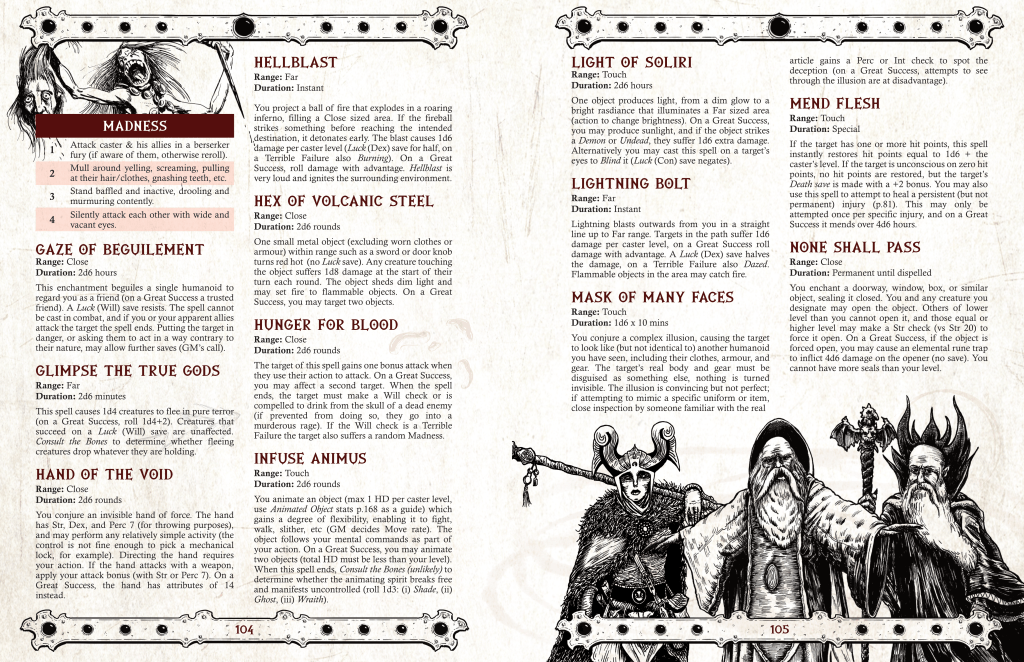
Note: “Consult the Bones” is an Oracle dice mechanic we’re using (a four dice variant of our Yes, No, But Die), but is easily substituted for either a flat 50% chance, or if likely 75% or unlikely 25%.
No Damage Interrupt

With a smaller number of spell slots (compared to LFG/OSE etc), and Roll to Cast, we’ve done away with LFG’s damage interrupt rule (which is of course a toned down variant of the old school damage interrupt rule).
If you want to stop a spell caster from using their magic – you know what to do ===>>
We’ve kept the rule about non permanent effects ending if the caster dies. So if you find yourself surrounded by allies who are paralysed, choking on sorcerous fumes, or fleeing in magical terror – take out that enemy caster!!
Dark & Dangerous Magic
Dark & Dangerous Magic is of course alive and well. We’ve made two tweaks:
(1) The DDM die is not always a d20. It ranges from d8 to d12 when casting spells (based on the level of the caster), or d20 when using a magical item. A massive thank you to JD RPG over on Discord for this idea! The purpose of this change is to make DDM trigger more often, which better suits short, sharp adventures. For those who prefer DDM as it is now, we’ve included a Variant Rule to that effect.
(2) Secondly, the handful of clearly beneficial entries in the LFG DDM table have been removed. It was always just so sad to see the disappointment on the players faces when they finally trigger DDM, only to gain advantage on their next spell roll … rather than grow a tentacle arm, speak in alien chittering, or lose their shadow! Of course, summoning an enraged demon or unleashing a random spell can sometimes be just what you need… But most effects are neutral or adverse. Very long term effects tend to be cosmetic or roleplaying in nature, but serious, permanent corruptions are possible.
Spell List & Pages
OK this post has gone on long enough! Here’s a Googledrive link to an 11 page PDF with (i) full PC spell list of 50 spells, and (ii) the spell entries. We’ve toned down some of the more outlandish names just a tad, and also included the classic spell name (in small font) in the lists for easier conversion with classic D&D.
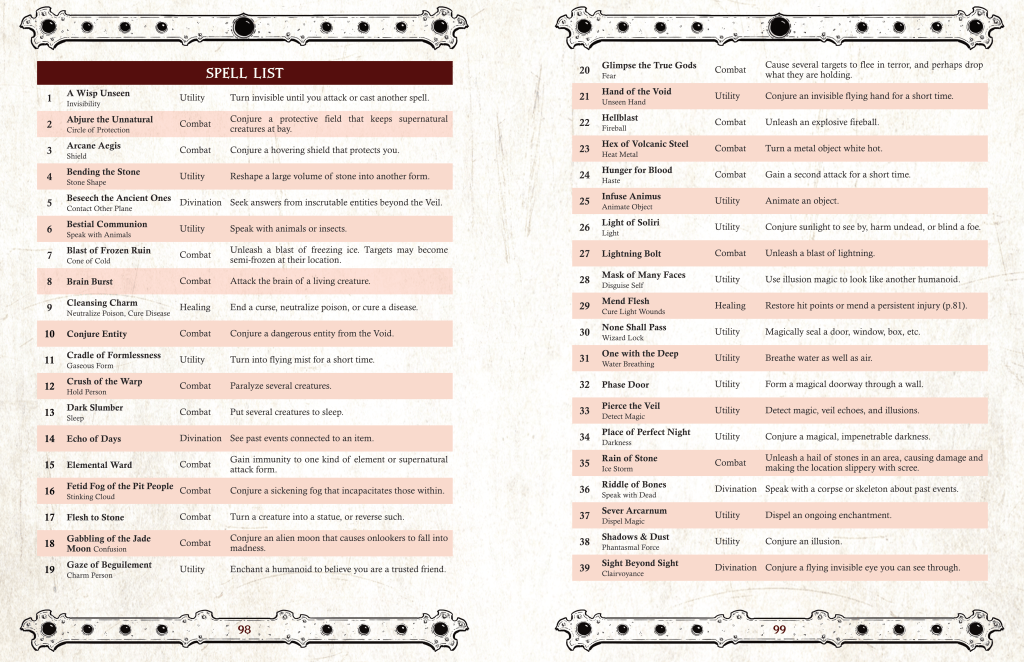
As always my friends the above is a WIP (including art), and will no doubt change with feedback and further playtesting. If you have any comments or suggestions please do give us a shout on the blog, Discord, or Reddit – we want to know what you think!!
And that’s the latest on Tales of Argosa y’all. Have a great weekend!
 Pickpocket Press
While from a gamer’s point of view I had no problems with the Vancian system, I’d always a strange note to it. Not from lore wise – I understand and even can enjoy this idea of spells being almost some sort of living thing, contained in a wizard’s mind, waiting to be freed and unleashed… but this is almost never backed up in terms of the power of the magic used. Sure, highlevel spells are of fearsome power, but… games have the notion to scale power… thieving abilities, fighter abilities, etc. and if you scale these mighty magic as they did in D&D they become less of sensible investment, especially at lower levels..
I see this as the leading cause for multiclassing in the first place (the original reason to compensate for level caps of non-humans was usually negated in my experience by ignoring the level caps).. to augment an otherwise almost incapable magic-user with something non-magical that he can enjoy. this one spell of medicore damage, limited duration, requiring a attack roll (as a wizard almost an insult) or saving throw for doing an amount of damage thae was only able to dispatch one or two foes with hit points around the amount of the wizard were just not worth it. that is why certain spell flourished, because the where able to generate the amount power, absolute result and the “my will be done”-notion… magic missle (will ALAWYS hit.. albeit with a laughable damage… we tried with a damage die equal to the hit die of the target and that was “ouch!”… but magic missile didn’t really needed a push), sleep (they fall asleep… done.. dispatch a horde.. power!)… invisibility (confers an allowance for certain circumstances that allow for a lot people dream of) …. charm person (sure, you have to pass a save, but if you do…and use it wisely.. cunningly as a wizard should… it lasts a loooong time)… (ireball (unctonrolled destruction par excellence)
so, the problem in my eyes is balancing power vs. scaleability…. if you make magic spells seldomly cast and hard to master… you have to make them powerful.. which nudges the whole gameplay to a helplessness vs. magic … which can only overcome by magic… which may or may not find appreciation with the players…. otherwise you are stuck with an apprenticeship of five to ten levels… which can also be great, but usually is out of sync with the notion that most people have one or two levels at most, if at all.
I think the best approach would be to make reduce the spell variety but increase the adaptability of those specific spells. A Hero’s Journey did a nice job by combining typical D&D spells in specific “flavor spell”… like a faerie type including sleep, charm person and speak with animals or something like that. that is one way to allow for more flexiability with a still restricted amount of spells and power. another approach would be generally allow for more flexibility in the effect, i.e. the parameters a spell has… like say, a “fireball” or “fog cloud” could be molded into any form and even made to last which would merge a fireball into a “wall of fire”.. and a fogcloud could be used to forme a humanoid or move with a person effectively blinding them… that would confer the feeling of control and power a wizard should have in my mind… not that dilemma of a fighter having a one-trick weapon..
status quo: “kill the bandits but don’t harm the hostages” – “ehm, i could kill them alright, but the hostages will get roasted by my fireball. got the raise dead ready priest?”
revised: “kill the bandits but don’t harm the hostages” – “sure” – WOOM, the bandits in an fireball equivalent radius erupt into flames leaving the hostages and even the plants between them unarmed (much to the delight of the druid) – “done” gasps of awe and fright… “but i warn you I can not do it again until I have harnessed that power again” .. makes sense…
LikeLiked by 1 person
I certainly agree that if you’re going to make magic dangerous and unpredictable, it ought to be quite potent to balance it out. In ToA many spells scale with level (like Lightning Bolt), there’s some save or dies in there, and Magic Users actually get a 5th level ability that helps curb DDM. I’m not too familiar with A Hero’s Journey I’ll have to check it out 🙂 For something like molding the fireball blast, you could certainly do that via a Unique Feature, but I dont think I’d build it into fireball itself (well, actually, that could be a good GS variant).
LikeLike
You mention memorisation at the beginning but I’m not sure with the rest of the post if that’s still included or not.
Will Magic Users still be capable of learning new spells from scrolls and writing them down? And can they swap out their memorised/chosen spells on level up or using downtime like in LFG?
There’s the grimoires but those sound like single spells. I’m moreso curious about using Spellbooks as loot and allowing Magic Users to change out their spells between books they collect or write during downtime. Will that still be possible?
LikeLiked by 1 person
No need to memorize spells or allocate spell slots ahead of time (same as LFG).
Yes you can use scrolls, spellbooks, and grimoires as loot! MU’s can learn spells from acquired scrolls and spellbooks, but they are limited to 1 new spell per level. Researching a new spell to learn without a captured book/scroll during Downtime requires time, silver, and an Int (Arcane Lore) check. With a captured spellbook it only costs time.
We’ve included a Variant Rule that allows any PC to swap out one known class ability for a new one when they level up, if they wish. Hope this all makes sense 🙂
LikeLike
Sweet! You’re working on a 2E for LFG! Where can I find out More? 🙂
LikeLiked by 1 person
Hey Will! Hope you are doing well 😀 Yes LFG 2e aka Tales of Argosa. I’m posting info here on this site, but also our Low Fantasy Gaming Discord is the best place. We’ve got some forums set up there for discussion (based on the posts here). We went with Discord forums (as opposed to the standard text channels) because it’s easier to read/find/retain info. Cheers brother!
LikeLike
One of the problems of going level-less with spells is that you really need to make sure all options are (at least roughly) equal. Much more than in level/circle/whatever based systems where people will usually forgive a couple spells per level being crap (or op respectively), since there’s plenty of choices at each.
Level-less lists by nature tend to have less spells, so each one that noticeably underperforms (or overperforms, which can be even worse) shrinks an already small list down to even fewer “viable” options.
Just as well, magic effects need to be adjusted to mechanical changes in the game. To take LL2090 as an example, when you flatten the HP curve and limit the maximum, as well as raise weapon damage (guns can easily do 3d8 or more, for (and to) a 1st level character), you kinda can’t leave spell damage as is.
Otherwise you end up with stuff like “Drelthar’s Galvanic Incanter”, which carries a risk to cast, uses a limited resource, is effectively worse than common guns at least to 4th level, BUT when cast by a 10th level Mage is basically an instant-kill unless you save (btw, I really do like the Luck mechanic). Taking normal D&D spell scaling into these heavily changed base mechanics just doesn’t gel well.
You see this a lot in other games too, official settings for Savage Worlds (usually of the sci-fi or cyberpunk variety) for example often have far stronger weapons than baseline assumptions account for, but do nothing to raise “power” damage, leading to damage powers being utterly worthless (which can be an intentional style choice…but oftentimes is just accidentally screwed up by not considering all implications).
These are just general observations. At a glance (no time yet for a full on analytical read-through) the draft list for ToA looks ok, and spell damage will only have to compete against (weaker) fantasy weapons. ou might still want to adjust low level spell damage upwards and high level spell damage downwards (flattening the curve to reflect the flattened HP curve, though obviously not as sharply).
LikeLike
Thanks for your comments FA, greatly appreciated!
Yes absolutely you’re right about high level mages being able to whoop ass with d6/level spells – but I think that’s ok. A high level mage should be scary. In LL 2090 in particular, a shotgun will take the Mage out with one hit, or a grenade the whole room (much like a spell, but without the Dark Flux risk). And as you say it’s a trade off; at lower levels the spell is not that useful, so it’s a mid to late game pick.
In ToA I am of a similar mind. I think very high level mages like 8th-9th should be scary. Although I must admit after playtesting we capped the effective monster HD “level” for casting purposes at 10th. So a 15 HD Lich does a 10 dice Hellblast, not 15. And really say level 8 mage with 8d6 lightning bolt, the average damage is about 32, save for half 16 – most PCs will survive one of those if they save, and PCs have access to shields, rescues, and possibly class abilities that will also assist.
Having said all that yes, this is an issue that is on our radar and we continue to playtest it – and look forward to feedback from folks once the draft PDF goes out 🙂 Thanks again for taking the time to comment, cheers!
LikeLike
Only 1 spell per level? How many spells total?
LikeLiked by 1 person
They start with spells equal to Int mod, then learn 1 spell per level for the next 8 levels. So total spells will generally be about 10-11? The MU has been standardised to be more like the other classes with “ability” picks. and is more like a 5e Sorcerer/Lowlife 2090 Mage than a traditional Wizard from dnd. There is an optional rule to allow “swapping out” a known spell for a new one when you gain a level too, if you want that flexibility. Obviously GMs could allow more, but the more spells they have available the more powerful they will be.
LikeLike
… I mean how many can a caster have by the time they are max level…
LikeLiked by 1 person
MU’s know 2-3 spells at 1st level, then up to 10-11 known at 9th. If you allow the swapping of 1 known spell for a new spell each level, they could go through about 18-19? If you wanted more than that I can see a UF where you get 3 more spells (over the three tiers).
LikeLike